
You have an idea for an AI product. It automates something your team does manually. Or the idea is about personalizing an experience for your customers. Either way, the idea feels clear until you start researching how to build it. Data pipelines. Machine learning models. AI systems. Development services. Suddenly, the development of the product feels like a hectic task.
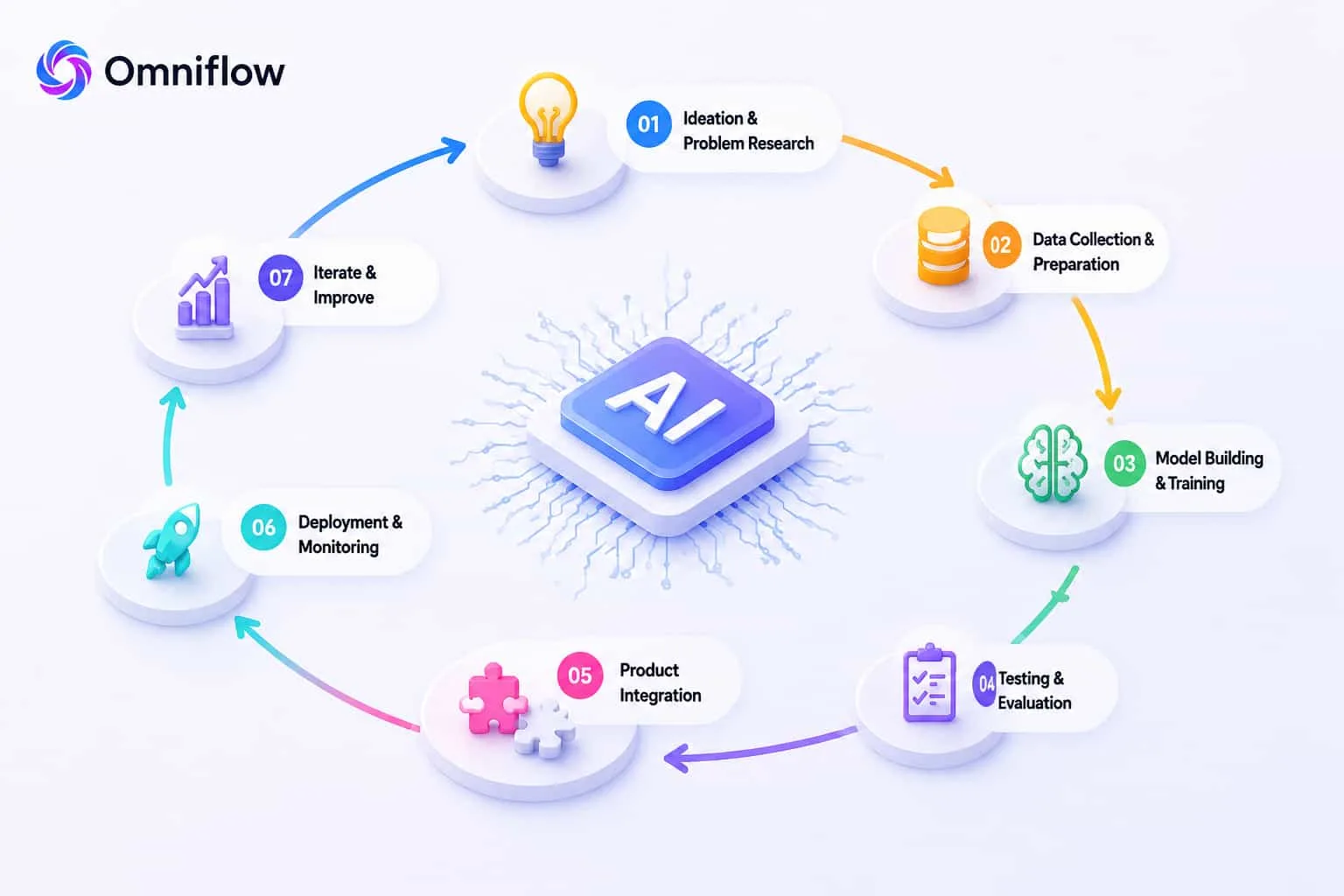 But no, the AI product development process is not as complicated as the internet makes it sound. You just need someone to explain it as simply as it is. And for that, stick in here.
What is the AI Product Development Process
Think of AI product development as the full journey from an idea to a working AI-powered product that real users can actually use. It covers everything: defining the problem, choosing the right AI solution, then building, testing, and making it live for the use.
What makes this different from regular software development is one thing: AI products are data-driven. A standard software product runs on logic you define upfront. An AI system learns from data and gets smarter over time. This changes how you plan, build, and test everything.
All you need is just a clear process, which is very beginner-friendly, with tools like Omniflow.
Why Most Beginners Get This Wrong Before They Even Start?
The most common mistake? Starting with the technology instead of the problem. Someone discovers a new AI model, gets excited, and starts building features around it. Three months later, they have something technically impressive that nobody needs.
The second mistake is trying to build everything at once. You have to pick one problem, build one solution, test it, and improve from there. Teams that try to launch a full AI platform on day one almost always develop it late, over budget, and underused. Get the process right from the start, and you sidestep both.
How to Start an AI Product Development Process for Beginners?
Start with a problem. It should be a real, specific, painful problem your target user faces today. Find the moment in their week where they waste time, make errors, or wish something just worked better. This moment is your starting point. You have to build from there.
Step-by-Step AI Product Development Process for Startups
Step 1: Define the Problem With Real Specificity
Write one sentence. The problem your product solves, for one specific person, in one specific moment. Try something like: "A small e-commerce team misses 30% of refund requests because customers send them through four different channels and nobody monitors all of them." This sentence tells who the user is, what breaks down, and why it matters. From there, you figure out whether AI actually helps and how.
Step 2: Decide Where AI Fits
Not every part of your product needs AI. Adding it where it does not belong makes the product slower and more expensive without making it better.
Ask: what is the one thing in this product that benefits from learning, prediction, or pattern recognition? That is where you should add your AI model. For the refund example, the AI classifies incoming messages and routes them. The dashboard, notifications, and reporting are standard software built around that AI core. Knowing where AI fits keeps your development process focused and your time to market realistic.
Step 3: Map Your Data Sources Before You Build
AI systems learn from data. Ask three questions: What data does the AI need? Does it already exist in the business? How do you keep it clean over time?
For most AI-powered products, the data already exists. It is in customer emails, support tickets, transaction records, usage logs. You just need a plan to connect those data sources and feed them into the AI model. If the data does not exist yet, build the collection mechanism first. That changes your timeline significantly.
Step 4: Build the Spec Before You Build the Product
A spec is a product requirements document (PRD) which defines exactly what you are building. It includes the core features, user flows, data model, how the AI component connects to the rest of the product, and what "working correctly" should look like.
Without a spec, the developers interpret things differently. The AI system is integrated without a clear definition of what it should output. You get a product that looks close but feels off and fixing it means expensive rework.
This is exactly where Omniflow comes in. You describe your product as simple as possible and Omniflow generates a structured PRD from that. You review it, adjust what is wrong, and then Omniflow generates the full UI/UX design and a working full-stack product tied directly to that spec. When requirements change, the design, data model, and interface all update together.
Step 5: Build the Core Product First, Then Layer in the AI
Start with the basic product flow working end to end. The user comes in, does the core thing, gets a result. No AI yet. Just the fundamental workflow running correctly.
Then add the AI component on top. This saves enormous time. When the core product works without AI, you know exactly what the AI needs to do and where it connects. You test the AI against a working baseline.
For the refund product: first, a human categorizes incoming messages manually. Then the AI model takes over. You check whether it matches human judgment, and improve it where it falls short. This is how real AI product development works.
Step 6: Test With Real Users Before You Make Decision to Scale
Real users interact with AI-driven products in ways you never predict. They ask things you did not train the model for. They find edge cases that your internal testing missed entirely.
Get the product in front of ten real users before you invest in scaling. Watch where the AI gives wrong or unhelpful outputs. Feed that behavior back into the model. Build, test, improve, test again. This loop is the core of a good AI product development process. Teams that skip it end up with an AI system that works in demos and breaks in real life.
Standard use cases such as text classification, image recognition, recommendation engines, all work well on existing AI platforms with light customization. Genuinely unique AI-driven products with specific business logic usually need a custom-built approach to hit the performance users expect.
Outsourcing the AI Product Development Process for Small Businesses
No in-house developers? Outsourcing parts of the AI product development process makes complete sense. Keep product definition and user research in-house. Outsource the technical build to specialist software engineers. And remember: development teams build exactly what you give them. A vague brief produces a vague product. A structured PRD produces something close to what you imagined.
Get the Sequence Right and the Rest Gets Easier
The AI product development process is not mysterious. Problem first. Data second. Spec third. Build fourth. Real user testing fifth.
Get that order right and building an AI-powered product becomes manageable instead of a months-long spiral. Omniflow helps you hold that sequence from day one. Describe the product, review the spec, validate the design before any code runs, and ship something that stays true to what you actually planned.
Start your AI product development process with Omniflow →
FAQs
How long does the AI product development process take for startups?
A focused prototype with one core AI component takes four to eight weeks. A full production-ready product takes three to six months depending on data complexity. Skipping the spec stage adds time it never saves it.
Can I outsource the AI product development process as a small business?
Yes. Keep product definition and user research in-house. Outsource the technical build to specialist software engineers. The quality of your spec determines the quality of what gets built.